What we carry · 02
Tarot & Oracle
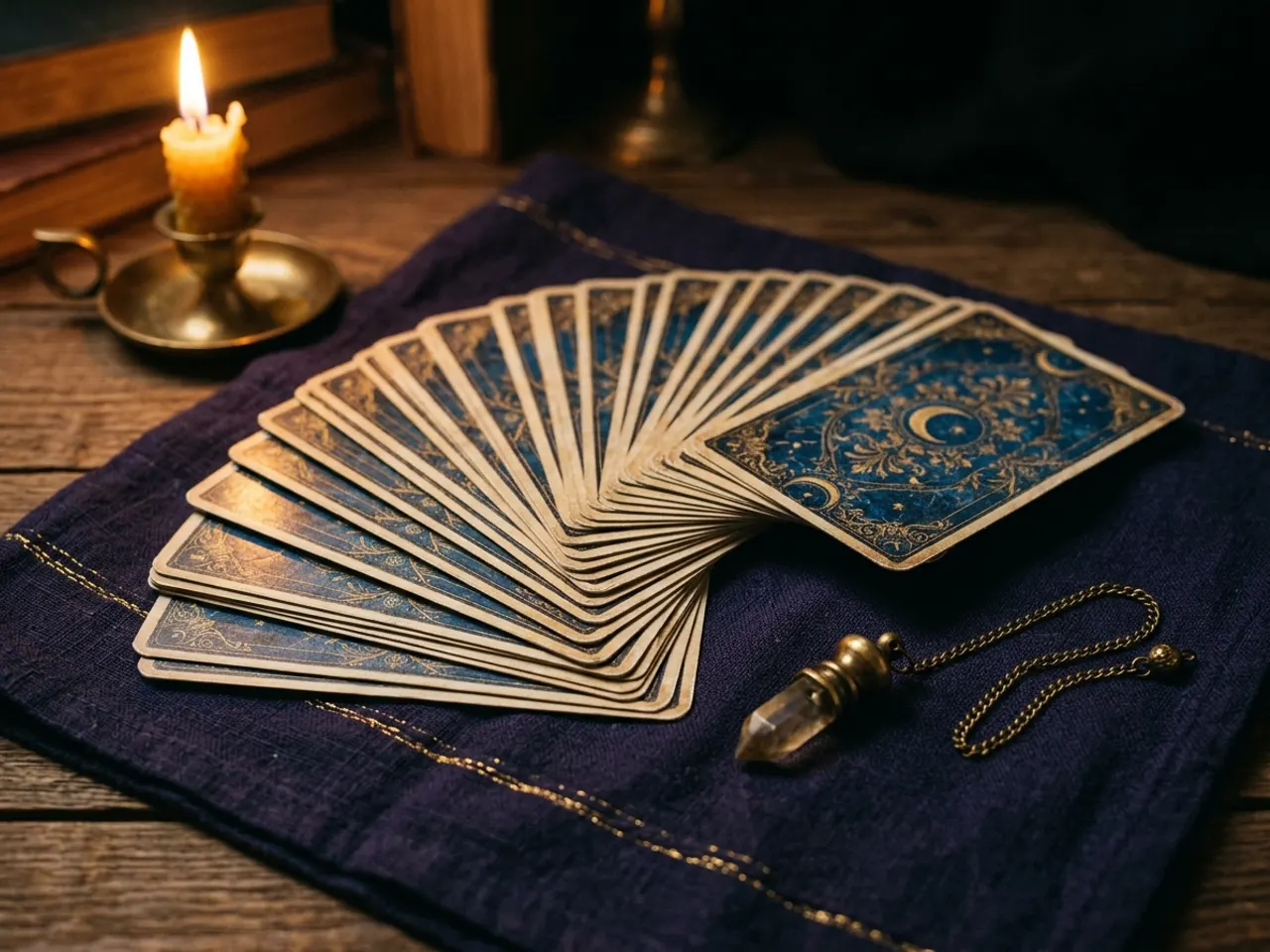
Tarot is a 78-card system — 22 major arcana, 56 minor — that has been used for reflection and divination since at least eighteenth-century Europe, built on card games older still. Every tarot deck shares that structure, which is why a tarot book can teach any tarot deck. Oracle decks are the free verse of the card world: each invents its own count, images and rules.
The Rider–Waite–Smith deck, illustrated by Pamela Colman Smith in 1909, is the reference point nearly all modern teaching assumes. It is a fine first deck precisely because everything explains it. From there, decks multiply by art and temperament — we stock dozens, from the classical to the contemporary, and you're welcome to ask to see any of them boxed behind the case.
Runes — an alphabet of Norse and Germanic letterforms cast or drawn for guidance — and pendulums, weighted points swung over a question, are the other divination tools on this shelf. Both are older, simpler systems that some people find suit them better than cards.
And if you'd rather watch the tools in practiced hands first: there is a reader in this shop seven days a week. Meet them here.
Common questions
What tarot deck should a beginner buy?
The Rider–Waite–Smith deck is the reference nearly every tarot book assumes, which makes it the easiest first deck to learn with. Oracle decks are a good alternative if you want imagery without the fixed 78-card structure.
What is the difference between tarot and oracle cards?
Tarot follows a fixed 78-card structure — 22 major arcana and 56 minor — shared across decks. Oracle decks follow no standard: each sets its own card count, imagery and system.